Product Images for Search Engines

SEO for WordPress eBook

Optimizing Your Product Images for Search Engines

Product images can make or break your online shop’s success. You can have a great product, but when images are good, sales will be right. Your product image is the first thing a customer will look for. These are the essential features of a product page when shopping online:

  • Quality of the product images
  • View products in all available colors
  • Alternate views of the selected item
  • Ability to zoom into the details of the product
  • Product guides

Choose the correct filename.

Image SEO starts with the correct file name. Of course, this is the first location to use that keyword. Without looking at the image, you want Google or any other Search Engine to know what the image is about. It is simple: if your image is a sunrise in Paris showing the Notre Dame, the file name should not be DSC4536.jpg but notre-dame-paris-sunrise.jpg. The main keyword would be Notre Dame, the photo’s main subject.

Your product images play a significant role, reflecting the meaning of your technology, vision, business, and hard work. Your product images should be a minimum 1024px in height, or 1024px wide, up to 2048px by 2048px, or 4.2 megapixels. Higher resolution photos will look more polished and professional to customers, or  1024px by 1024px as a guideline for square product images.

Quality of your product images

It seems so obvious to use high-quality images. Do not use a small, blurred, faded, or fuzzy image. People are visual beings, so they will judge your product based on its photo and content regardless of how fantastic it is! The sale is only possible if the product image reflects your product and its details well enough.

A product image with good size, high resolution, and correct file name e.g., notre-dame-paris-sunrise.jpg. Ranks better for the keyword it is optimized for.

A Good Meta Description for SEO and Social Media

Sophia the Humanoid Robot

Sophia is Hanson Robotics’ latest and most advanced robot to date and a cultural icon. She has become a media darling, appearing on major media outlets around the world, igniting the interest of people regardless of age, gender, and culture, even gracing the cover of one of the top fashion magazines. Her press coverage has a potential reach of over ten billion readers in 2017.

Sophia is a highly sought-after speaker in business and showed her prowess and great potential across many industries. She has met face-to-face with key decision makers in banking, insurance, auto manufacturing, property development, media, and entertainment. In addition, she has appeared onstage as a panel member and presenter in high-level conferences, covering how robotics and artificial intelligence will become a prevalent part of people’s lives.

Leaps Small Buildings in a Single Bound- SandFlea

Sand Flea drives like an RC car on flat terrain, but jumps 10 m into the air to overcome obstacles.

Sand Flea is a small robot with 4 wheels and a mighty jumping leg. It drives like an RC car on flat terrain, but can jump 10 m into the air to jump over obstacles. That is high enough to jump over a compound wall, onto the roof of a house, up a set of stairs or into a second story window.

The robot uses its wheels as gyros to stay level during flight so the operator gets a clear view from the on-board camera and to ensure a smooth 4-wheel landing. Sand Flea can jump about 25 times on one charge. Boston Dynamics developed Sand Flea with funding from the US Army’s Rapid Equipping Force (REF), DARPA and Sandia National Laboratory.

SandFlea is currently out of production.

By Boston Dynamics

Humanoid Robots will Fill Public Service Positions Throughout the World

As time goes by, we will be seeing highly intelligent Humanoid Robots and Autonomous Machines filling public service positions throughout the world, operating under rules to keep humans safe, and in the future, be taught to protect and even save lives, improving our overall quality of life, or maybe not, because it all depends how we program them. Despite limited resources, including semiconductors, AI, and financial difficulties, our limitless desire for robotics will force us to investigate the possibilities of designing human-like robots for all areas, from farming to service industries, medical, health and research, education, entertainment, and combat. With the help of robots and creative minds, we will discover more as we move forward.

With open-source codes developed by human programmers or robots, you can teach your robot higher-level tasks, including anything from karate to doing the dishes to teaching it how to sing or dance. Wi-Fi will also affect their remote access; firewalls and antivirus apps will be available to protect your precious robot from unwanted remote breaches.

Today’s only challenge with advanced Humanoid Robotics is determining how strongly we can design them for pre-recorded or instant responses. Can they fully decode human speech and surrounding sounds with their voice recognition, regardless of all accents, to understand human perception and cognition? Maybe not yet. How can we help them to understand anger or calmness? A physical punch on a robot or the stress level in our voice and body language, for example, has to be translated into a form for them to recognize with codes and sensors. Robots are currently and will in the future be taught to protect and even save lives, improving our overall quality of life. They will be walking on the ground, swimming in the oceans, and flying with a combination of available drones. It is a phenomenon, an important one, not to miss out on.

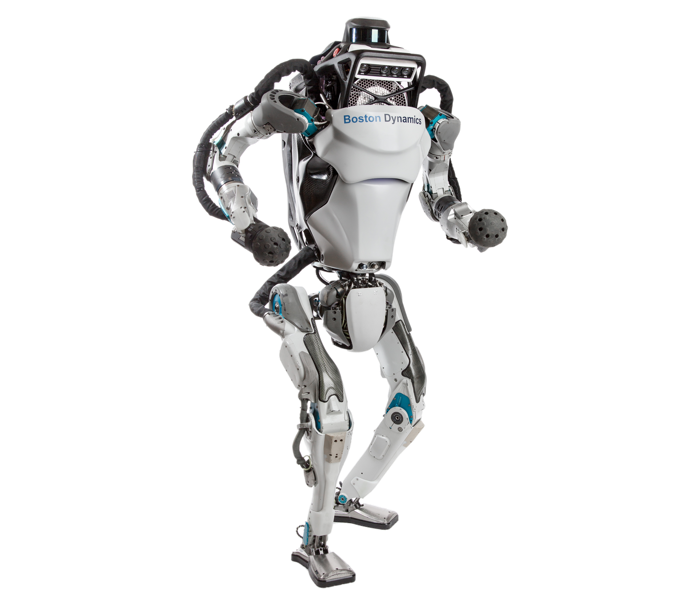
The World’s Most Dynamic Humanoid Robot

The World’s Most Dynamic Humanoid.
Atlas uses balance and whole-body skills to achieve two-handed mobile manipulation.


Atlas is the latest in a line of advanced humanoid robots we are developing. Atlas’ control system coordinates motions of the arms, torso and legs to achieve whole-body mobile manipulation, greatly expanding its reach and workspace. Atlas’ ability to balance while performing tasks allows it to work in a large volume while occupying only a small footprint.

The Atlas hardware takes advantage of 3D printing to save weight and space, resulting in a remarkable compact robot with high strength-to-weight ratio and a dramatically large workspace. Stereo vision, range sensing and other sensors give Atlas the ability to manipulate objects in its environment and to travel on rough terrain. Atlas keeps its balance when jostled or pushed and can get up if it tips over.

By Boston Dynamics

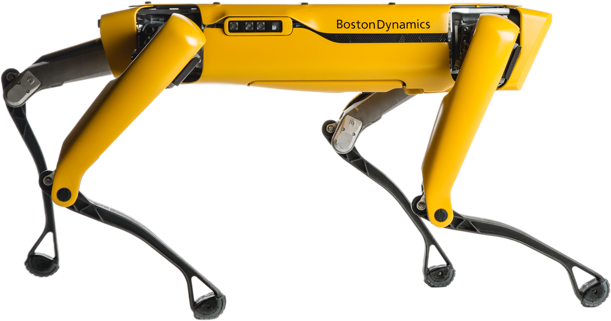
A nimble Robot that handles objects, climbs stairs, and will operate in offices, homes and outdoors

A nimble robot that handles objects, climbs stairs, and will operate in offices, homes and outdoors.


SpotMini is a small four-legged robot that comfortably fits in an office or home. It weighs 25 kg (30 kg if you include the arm). SpotMini is all-electric and can go for about 90 minutes on a charge, depending on what it is doing. SpotMini is the quietest robot we have built.


SpotMini inherits all of the mobility of its bigger brother, Spot, while adding the ability to pick up and handle objects using its 5 degree-of-freedom arm and beefed up perception sensors. The sensor suite includes stereo cameras, depth cameras, an IMU, and position/force sensors in the limbs. These sensors help with navigation and mobile manipulation.

By Boston Dynamics

A Robot with Legged Squad Support Systems

A Robot with Legged Squad Support Systems

LS3 was funded by DARPA and the US Marine Corps. Boston Dynamics assembled an extraordinary team to develop the LS3, including engineers and scientists from Boston Dynamics, Carnegie Mellon, the Jet Propulsion Laboratory, Bell Helicopter, AAI Corporation, and Woodward HRT.


LS3 was designed to go anywhere Marines and soldiers go on foot, helping carry their load. LS3 carries 182 kg of gear and enough fuel for a 32 km mission lasting 24 hours. (In one test on flat terrain LS3 carried over 500 kg of payload.) LS3 automatically follows its leader using computer vision, so it does not need a dedicated driver. It also travels to designated locations using terrain sensing, obstacle avoidance and GPS.